DIY Toilet Projects
Did my videos just save you a bunch of time and money?
Would you like to help me keep producing more?
Toss a dollar in my Tip Jar via Paypal! Safe Secure and any amount is appreciated!
Or just leave a comment here.
Thanks,
Greg

How to find and fix a toilet leak
Greg shows how to diagnose a toilet leaking from the tank into the bowl
Clearing a clogged toilet
using a closet auger
Our Most Popular Video!
See how to clear a toilet clog the right way. The way the professionals do it!.
Cleaning and repairing a ballcock Valve
Running toilet? A simple cleaning of the tank's fill valve may be all it takes.
Why NOT to use a plunger on a toilet!
Why Greg doesn't carry a plunger in his plumbing tools. Did you know it can make a clog worse, damage your toilet, and even lead to illness?
Roots in the toilet drain
Roots invade the toilet drain and lead to flooding the entire house. See the diagnosis, repair, and prevention.
A two part video.
more...
How to replace and buy a flapper
Greg shows how to remove your current leaky flapper valve and provides tips on buying the proper replacement part.
Also, covered: Common mistakes in installation.
Frequently UNasked Questions
- Why does a toilet tank sweat and what can you do about it?
Technically speaking your toilet tank sweats when the air around it is cooled to the dewpoint and condensation forms on the outside of the tank. This requires a cool tank and a moist environment. The cooler the exterior of the tank, the less moist the air in the room has to be to form the condensation.
When the toilet is flushed, the tank refills with cold water. Exactly how cold may depend on the season and the source of your water. The mass of the tank itself holds some heat which tempers the cooling of the tank wall to some extent. In a proper functioning toilet the water in the tank warms to room temperature in a short amount of time. If the tank sweats for just a short period of time a few minutes after the toilet is flushed then that is simply indicative of a combination of a cold water supply and moist air in the bathroom. You could turn up the heat in the bathroom, ensure the ventilator fan is functioning properly.
In a tank that sweats continuously, then the tank is being kept cold by a continuous supply of cold water. Therefore, a sweaty tank is usually a sign of an internal toilet leak, assuming – of course that there isn’t a puddle on the floor. There are two basic places a toilet can leak like this, the overflow tube and the flapper valve. These leaks can be both completely silent and difficult to detect to the casual observer.
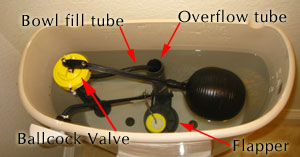
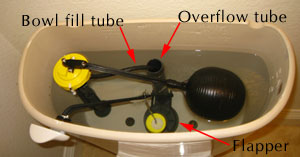
The first and easiest place to check is to see if the tank level rises to the top of the overflow tube. The normal level is at least a quarter inch below the top rim.

If water rises to the top edge of the tube, a slow flow down into this tube will require a continual supply of water to keep the tank filling. This condition can be caused by either a caused by a maladjusted float or a fill valve that just won’t completely shut off.
If you can lift the float with your hand high enough that the water shuts off and stays off then the problem is the float adjustment. To cure this condition you want the float to be lower in the tank when it is at its highest point than it currently is. Depending on your toilet’s ballcock valve design, there will be an adjustment screw or other means to tweak the level at which the water shuts off completely (or you could gently bend the float rod slightly down- but this is not the best method as the rod can turn over time and cause the problem to reoccur).
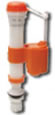
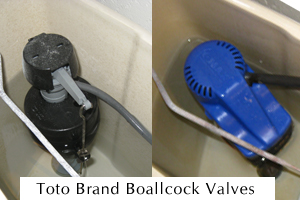
It is also possible that the ballcock valve itself is not fully closing no matter where how high the float rises. This could be caused by dirt or debris in the valve itself (solids particles in the water supply are very common). Some valves may be easily disassembled and cleaned (see my video on Cleaning and Repairing a Ballcock Valve) others are just as easy to replace with inexpensive replacements from the home center.
The other probable leak location is in the flapper valve at the base of the tank. The flapper valves only last so long, and their life can be significantly shortened by toilet cleaner chemicals that are placed in the tank. The good news is that they are easy to replace. (Watch for a video on that subject soon)
If the water in the tank is not flowing over the top of the overflow tube, this is the likely cause. You can then verify that a flapper valve leak exists with a leak detector dye (intended for this purpose) or a good amount of food coloring (see my video on How to Find and Fix a Toilet Leak). After putting the colorant in the tank, wait about 10 minutes to see if the dye appears in the bowl. If it does, then you have confirmed that you need to take some action, as the leak is not only causing the condensation to form, but a great deal of water is being wasted needlessly.
- Why some toilets don't flush well.
First, lets start off by explaining how a toilet is supposed to work. The passage leading from the bottom of the bowl to the drain pipe has a vertical bend it. Like all household drains this maintains some water in the base of it to prevent gasses from the septic system from seeping into the house (this is the trap below all other drains). Before the waste water goes into the waste piping, the water must go up over this vertical bend. If the vertical bend in the pipe (the trap) can be quickly filled when the toilet is flushed, a siphon will be formed and draw (suck) the contents of the bowl into the drain system. To adequately start this siphon action, the initial water flow from the bowl must be of sufficient speed and volume to completely fill the trap and the passage and initiate the flow of the bowl contents via the siphon action.
When you push a toilet tank lever, the lever lifts a flapper on the flush valve which releases the water contents of the tank into the bowl, via the siphon jet (at the bottom of the bowl) and the flush ring (the rim of the toilet with the little holes in it). The siphon jet initiates the flow of water from the bowl into and through the trap and starts the siphon action . The continued flow of water into the bowl from maintains the level of water in the bowl to support the siphon until all the waste contents can be emptied. In top performing toilets, this happens in less than 2 seconds.
There are other bowl designs that don't use the siphon jet, but the basic operation is the same and this design is the most common.
By the way... The spinning of water in the bowl during the flush sequence is actually counter productive to the flush action.
Toilets may not flush well for a number of reasons.
- Toilets are cast out of many pieces of ceramic (china), these pieces fit together and then are glazed and fired to look like one smooth pice. However, if the inside the passageway of the toilet is not smooth (often because it is not glazed), the siphonic action (i.e., the flush) is weak, and the flush does not evacuate the contents of the bowl completely. The resolution is to have a quality High Efficiency Toilet (HET). The design and manufacture of these toilet ensures a smooth passage way for a strong siphon.
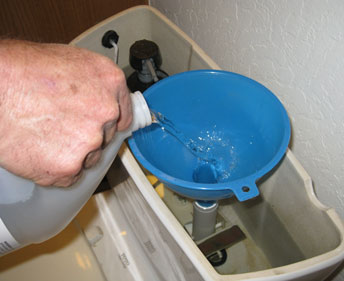
The transfer of the water from the tank to the bowl can be impaired by mineral buildup in the flush ring and siphon jet. The slower the transfer the poorer the flush. The mineral build up and reduces the initial flow of water into the trap, resulting in a poor siphon. The resolution is to quickly poor about a quart white vinegar down the overflow tube (located in the toilet tank). Let the vinegar work for a minimum of about 2 hours (preferably overnight) before flushing. It may help to first remove the small 1/4 inch bowl fill tube that comes from the ballcock and to the overflow tube. The vinegar dissolves the calcium (hard water build up) in the flush ring and the siphon jet, allowing the toilet to once again work as designed. You may need to repeat the process several times. Annual treatment could be necessary.
See my video on Improving Flush Performance.- The bowl fill tube no longer discharges into the overflow tube. If the bowl fill tube does not empty into the overflow tube, the bowl will not refill after flush. Starting out with a low bowl water level will result in a poor flush. The resolution is to reconnect the bowl fill tube to the overflow with a clip, to keep the bowl fill tube in place. It's also important is to ensure the bowl fill tube does not extend too far down into the overflow tube (1/4 inch) or constant cycle of tank-siphon loss and refill could occur.
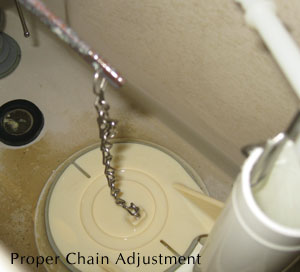
The chain from the handle to the flapper valve is not properly adjusted. If the chain is too long, the flapper valve does not lift up enough to move to the fully open position (where it normally floats until the tank water level drops enough to allow the flapper to close). If the chain is too short, the flapper valve may be prevented from fully closing or from opening enough. The resolution is to adjust the chain length so that the slack in the chain is 1 or two links (no more, no less). A loose flush handle can be the cause of inconsistent adjustment of the chain, resulting in the above problems, and is a common cause.
- The flapper valve is binding on something and cannot operate properly. The valve may be colliding with toilet bowl cleaner, or other objects in the tank. A similar problem arises from installing the wrong flapper when replacing one, or installing it improperly (Many flappers are designed to fit different types of flush valves, some flappers may require cutting some pieces away for proper installation - Read the Instructions!).
- The bowl trap has an object in it, such as a toy, toothbrush, shaver, paper towels or other object that has fallen into the bowl and hung up inside the trap (which is only about 2 inches wide with sharp turns). The resolution is to use closet auger (toilet auger). Available for about $30 at a hardware store, or for rent at the local rental outlet.
- Why does a toilet leak?
Let's first define what a toilet leak is, and differentiate it from your toilet running (or filling) constantly. We'll consider a leak to be water on the floor (water is leaking out of the toilet).
If you have a leak (water on the floor), it could come from:
- A leak at the tank to bowl spud (the flush valve gasket) or a leak at the tank to bowl bolts (which each have a rubber gasket). In either case, replace both the bolts and the spud. Both readily available at the hardware store.
- A loose ballcock nut. This is located on the outside bottom of the tank, and would cause water to flow down the outside of the supply line and drip. It may first appear to be a supply line leak.
- The supply tube nut is loose (at the base of the tank).
- The supply valve is leaking.
- The bowl wax seal no longer seals. This is actually rarely the problem and always caused by some other issue such as a loose toilet, sagging floor, or improper wax ring installation in the first place.
- The bowl fill tube had come out of the overflow tube and is now spraying out between the tank lid and the tank, running down the side of the tank onto the floor. Open the lid of the tank, flush the toilet, and see where that little 1/4 inch tube is aiming.
- A cracked tank. Rare, but a possibility.
If your toilet is running, and the constant filling is on and off, then it could be one of several things:- Flapper valve warped or not closing.
- Bowl fill tube siphoning (the bowl fill tube is too far down into the overflow tube in the tank, resulting in a constant cycle of partially draining and filling the tank)
If the constant filling is non-stop, then it could be:
The ballcock mechanism (the float in the tank) could be catching or hanging up on something.
- The ballcock valve has sediment in it an needs to be cleaned out. See my video on Cleaning and Repairing a Ballcock Valve.
- The ball cock valve has failed and should be replaced.
- Why don't you use a plunger to clear a toilet clog?
You may be surprised to know that I don't even have a plunger among my plumbing tools! While this has been used by many people for many years, using it for a toilet is not a very good idea. Here's why:
- It could push the blockage even further down the pipe. If the blockage was due to something that won't dissolve like a comb, now you've really got problems. You may have to open up the floor or slab to get at the blockage or hire someone with an expensive camera outfit to go in and find it.
- The pressure exerted by the plunger could blow out the wax seal, without you knowing it. Even with the wax seal compromised, it may work fine...for a while. But a subsequent blockage would allow water (sewage) to leak out of the damaged seal and into your floor, under your tile, and making a general nasty mess of things.
- "Toilet matter" could be pushed up into the siphon jet of the toilet (that's the little hole that water comes out to help the toilet start to flush). Water is supposed to come out of that hole, and nothing should go in. There's no good way to clean that out once anything gets up in there, so that could cause long term problems for that toilet.
- It can splash! You certainly don't want any "toilet matter" splashing around, on to your face, clothes and the room itself. Not only is it unsightly, and nasty to even think about, it is a genuine honest-to-goodness health hazard!
So, what should you use to clear a toilet clog? A closet auger. They are the right tool for the job and affordable too. It's what I use. Watch my video on using a closet auger to see exactly how to use one.
Home Page| About Us | FUQ | Dishwashers | Drains | Faucets | Pipe | Toilets | Tools | Water Heating | Privacy Policy | Blog | RamonasPlumber.com | Site Map